Draft: compositing CSS filters on an intermediate surface
This draft includes a production native Canvas filter path with SVG fallback, an interactive demo and a separate test-only prototype. It does not change the public API. PR #239 remains Draft; the original 2.4.3 release does not include these changes.
Historical report. This is the original design note for the filter-surface compositing work (PR #239 era). The design has since landed and evolved; the note is retained as a design record, including the native WebKit discrepancy policy.
For current user-facing behavior, see CSS filters and layer opacity. For the native backend, validation and measured remaining performance limits, see the production fast-path report. Historical experiments below retain their original measurements; they are not current-run performance claims. The nested outside-shadow policy was accepted by the maintainer on 16 September 2026, as recorded in the discrepancy section below.
The base is 60cb8bdd925fd7c56cd423d6e2127da177a97279 (version 2.4.3).
Reproduce
- Run
pnpm installandpnpm build. - Run
pnpm exec tsx tests/server --port=8091 --cors=8092. - Open
/tests/reftests/filter/compositing.html?run=falseon that server. - Remove
?run=falseto use the standard DOM/capture comparison. - Add
?run=false&prototypeto compare with the test-only SVG filter path.
The fixture uses local HTML and inline SVG only. It requires no application, account, external image, web font, or proprietary asset.
Interactive HTML demo (removed)
The /tests/manual/filter-lab.html before/after demo was removed on 2026-09-28 together with the pinned html2canvas-pro-baseline dependency it compared against. Its findings are retained below as a historical record.
The demo tested actual Canvas blur behavior instead of inferring it from a user agent string. Safari and WebKit-based webviews are a compatibility focus, but the compositing bugs are not exclusive to webviews: Chromium reproduces them too. A genuine macOS WKWebView host has also been tested, as documented below; iOS devices and Android WebView hosts have not been tested directly. The Canvas filter documentation and WebKit implementation tracker provide context; runtime support still needs to be checked on the target device.
The before column imported the unmodified published html2canvas-pro@2.4.3 ESM bundle through an exact dev-dependency alias, with its integrity pinned in the lockfile; pnpm build copied it to ignored build/, never into the published dist/ package. The after column used this branch's normal renderer. Both received the same DOM, dimensions, scale and stylesheet readiness hook. No effects were removed from either capture. Examples without effects provided a control and should match. The separate SVG prototype remains available in the minimal reproduction.
The default overlapping-children example shows the combined defect immediately. The matrix keeps all eight presets for each source, so reviewers can inspect individual effects as well as combinations.
The demo does not upload results or fetch external assets. The first comparison runs automatically after the page and renderer load. Subsequent captures are explicit; changing controls invalidates previous playground output. Capture failures clear stale downloads and leave the controls available for retry.
The hosted demo exposed a clone stylesheet race that fast local responses hid. The clone's initial load can complete before adopted stylesheet links load, turning a 280 × 220 fixture into an unstyled, wide text line. Both demo capture paths now await cloned stylesheets and fonts in onclone, then verify that the fixture kept its size. A stylesheet failure produces an error instead of a misleading successful PNG. This is a demo safeguard; general stylesheet readiness in the document cloner remains separate from the filter renderer integration.
The manual demo was exercised in Chromium 148 and Playwright WebKit 26.4 across 128 source/preset/scale combinations. After-renderer center alpha matched 128 for 50% opacity and 255 for fully opaque presets. Native screenshot comparisons had mean absolute RGB error below 3/255 for each combination; this is a tolerance, not pixel equality. Zero opacity, negative offsets, capture failure/retry and viewport widths 320, 390, 720 and 1440 pixels were also checked. The WebKit runtime reported unavailable Canvas blur, while Chromium reported working Canvas blur.
Published-release before/after evidence
The actual published 2.4.3 bundle was compared with the draft in Chromium 148 and Playwright WebKit 26.4: 4 sources × 8 presets × 2 scales × 2 engines. All 128 after captures passed native DOM screenshot comparisons (mean RGB error below 0.39/255 in Chromium and 1.19/255 in WebKit); no-effects baseline controls also passed. The combined overlap center changed from alpha 239 to 128 at 1x in both engines, as expected for 50% opacity. The regression probe that asserted this baseline defect and its fix was removed on 2026-09-28; the screenshots below remain the evidence.
These are real macOS Safari 26.5.2 screenshots of the local demo, captured through the native browser UI at 1x capture scale. In this runtime Canvas 2D blur is unavailable. Left: native DOM; center: unmodified published 2.4.3; right: draft PR #239.
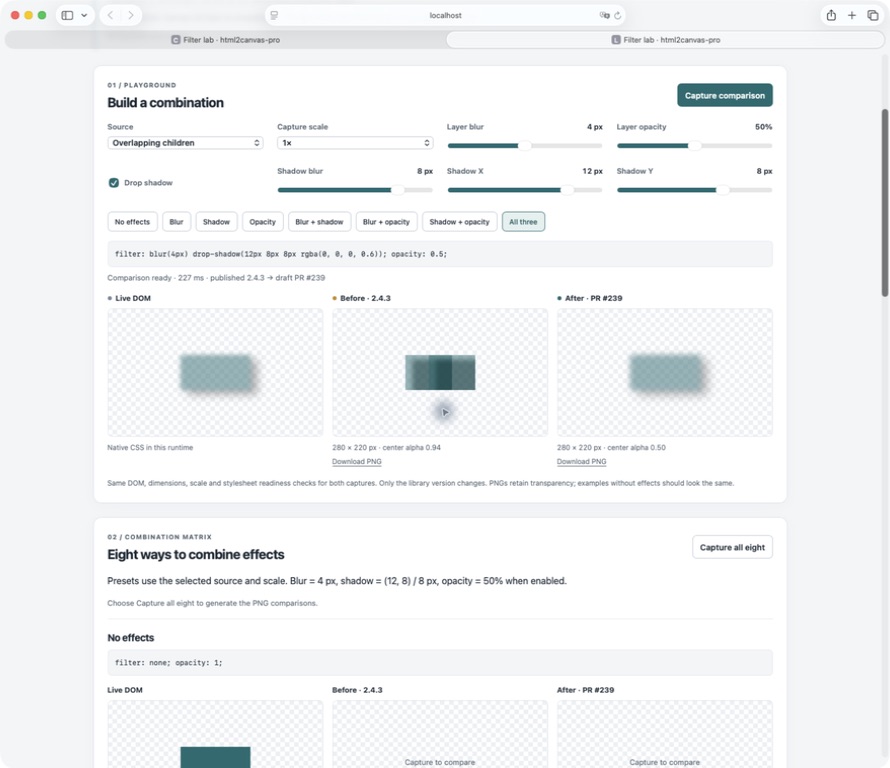
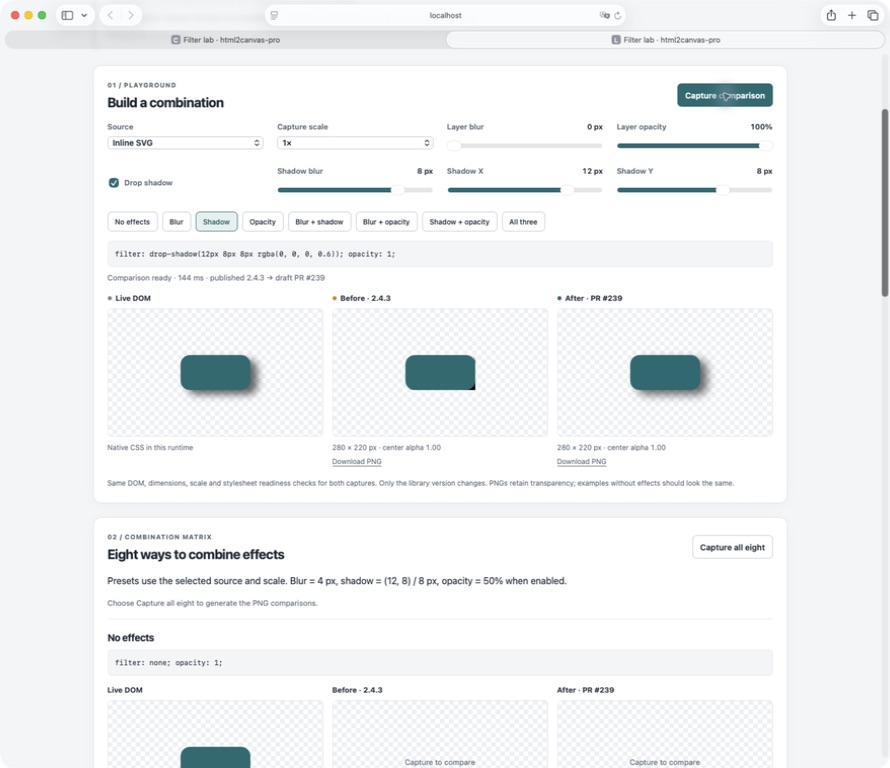
Safari visually reproduced the missing blur and darkened overlap before the fix. The after column retained blur and the expected 0.50 center alpha. These desktop Safari checks do not establish correctness in an embedded WKWebView host.
Pixel probe (removed)
scripts/filter-compositing-probe.mjs compared the renderer against native DOM screenshots in Chromium at 1x and 2x, covering nested opacity, source/ancestor clipping, the still-unfixed SVG overflow case, delayed demo stylesheets and failed stylesheet loading followed by retry. It was removed on 2026-09-28; the Chromium and WebKit reftests above remain the automated pixel coverage.
Cases
- An inline SVG with a CSS drop shadow must retain pixels outside its content box.
- Two overlapping children with a parent blur must be filtered as one image.
- Parent blur, drop shadow and 50% opacity must not darken the children's overlap.
- An inline SVG with visible overflow must retain the outside half of its stroke. This last case is reproduced only; the prototype does not fix SVG bounds.
In the 2.4.3 baseline, EffectsRenderer applies filter and opacity state to individual canvas draws. renderReplacedElement clips its draw to the element's padding box. These operations do not provide an intermediate surface for the complete filtered subtree. In addition, assigning ctx.filter cannot provide blur on engines that do not implement Canvas 2D filters.
Initial renderer integration
CanvasRenderer rasterizes eligible filter/opacity stacking contexts on an intermediate surface. It applies blur followed by one shadow, then opacity, and composites the result in z-order. Source effects stop at the surface boundary, so ancestor and nested opacity do not get applied twice. Capture bounds gain padding for blur and signed shadow offsets.
The production helper now checks actual native blur and colored shadow pixels, uses Canvas filters where that probe succeeds, and retries SVG for recoverable native failures. Both backends apply layer opacity after filtering. Opacity-only layers skip the probe. This backend selection is separate from surface eligibility: returning to SVG preserves layer composition, while returning to the previous subtree renderer does not gain the new compositing guarantees.
This first integration only handles untransformed subtrees without non-normal mix-blend-mode, non-unit zoom, list markers or clip-path. Relevant ancestors are checked too. Unsupported filter chains, including blur(5px) brightness(2), reversed shadow/blur order and multiple drop shadows, retain the existing renderer path. CSS opacity is supported separately; filter: opacity(...) is outside the subset. See supported combinations and fallback behavior. Nested opacity and filters, ancestor clipping and clipping before blur have focused checks. SVG paint bounds, general filter chains and transformed/blended surfaces remain outside this scope.
Filter parsing also preserves units and functional colors: blur(5px) no longer becomes blur(5pxpx), hue-rotate no longer duplicates its unit, and nested rgba/rgb color functions retain their arguments. Non-empty filters create a real stacking context.
The 128 demo comparisons were rerun against the initial integrated renderer. Both renderer and prototype stayed below 0.39/255 mean absolute RGB error in Chromium and 1.19/255 in WebKit. Center alpha matched every expected 50% / 100% preset. Two nested 50% opacities produced alpha 64 in both engines. These results do not prove arbitrary-page equivalence.
The initial integrated build, lint, 1,195 unit tests and 113 Chrome reftests passed. The committed pixel probe also passed in Chrome 152 at 1x and 2x. The Karma suite checks successful rendering, not pixel equivalence; the probe checks pixels for the focused filter fixtures. Later validation and measurements are recorded in the production native fast-path report.
Prototype
tests/manual/filter-compositing.js captures one untransformed layer without its parent filter and opacity. It applies blur followed by a single drop shadow to the raster via SVG, then applies opacity while compositing the result. Both engines exercise this SVG path; it does not depend on Canvas 2D filter support.
The shadow uses Gaussian blur, offset, flood and composite primitives, rather than feDropShadow. Filters use capture-pixel coordinates and sRGB. The SVG contains an embedded PNG, with no foreignObject or external resource.
The experiment deliberately uses known fixture parameters and generous bounds. It is not a general filter parser or a production wrapper around html2canvas.
Initial measurements
The fixtures were checked against native DOM screenshots in Chromium 148 and Playwright WebKit 26.4, at both 1x and 2x. The SVG path ran in both engines.
Mean absolute RGB error on a white background, per channel on a 0–255 scale:
| Case | Chromium baseline → prototype | WebKit baseline → prototype |
|---|---|---|
| SVG shadow | 4.54–4.57 → less than 0.001 | 4.29–4.32 → 0.52–0.60 |
| Parent blur | 3.34–3.67 → 0.015 | 3.33–3.96 → 0.096–0.097 |
| Blur + shadow + opacity | 11.25–12.14 → 0.075–0.081 | 11.24–12.01 → 0.27–0.30 |
The combined fixture's overlapping center has alpha 239–240 in the baseline capture, versus 128 in the prototype (expected 50%). Outside SVG shadow pixels have alpha 0 in the baseline capture and 73–74 in the prototype. These are focused fixture results, not a claim of general rendering equivalence or a full Safari UI test. The native WebKit shadow discrepancy is documented separately below.
Surface bounds, errors and cleanup
If native filtering is unavailable or fails recoverably, the SVG backend is tried on the completed surface. When that SVG path cannot serialize tainted pixels, CSP blocks its data image, or decoding fails, the affected subtree returns to the previous renderer. A working native path does not need a data image and can retain surface composition under such a CSP. This preserves allowTaint: a permitted cross-origin image still returns a canvas whose pixel reads raise SecurityError. Abort remains an AbortError; it interrupts a stalled decoder promptly and is never converted to fallback. SVG decode waits have a 10-second ceiling.
Temporary canvas backing stores are cleared on success, failure and abort. Failed internally allocated output canvases are cleared; caller-supplied canvases remain caller-owned. Clone cleanup runs in finally, preserving removeContainer: false.
Surfaces use conservative subtree bounds: overflow descendants, text ink padding, box/text shadows and nested filter outsets. Capture crops include nearby pixels that contribute through signed offsets or blur. Each capture shares a reservation of 16,777,216 intermediate raster pixels (64 MiB of RGBA), counting four rasters per active surface conservatively, with sides capped at 8,192 pixels. This bounds intermediate backing stores, not the caller's output or browser encoder overhead. Over-budget subtrees use the previous path before allocation, without downscaling. Outset box shadows inside a source surface use a visible silhouette and the same filter helper, which selects native filtering or SVG. Linux WebKit lost the interior of shadows from off-canvas Canvas masks; a smaller displacement did not fix it. The silhouette path shares the capture budget and cleanup. An even-odd clip preserves the rounded border-box cutout without reversing Bezier curves. Tests cover transparent rounded boxes, multiple box shadows, signed offsets and negative spread at 1x/2x. Inset shadows retain the previous path, with capture-scaled metrics in a source surface.
node scripts/filter-surface-regressions.mjs compared Chromium/WebKit pixels at 1x/2x across z-order, nested signed outsets, overflowing text and box shadows, offset crops, transformed/rotated/zoomed/blended/clipped ancestors and descendants, unsupported filter chains, real taint, CSP, decoder failure, abort and cleanup, including unsupported subtrees against the published release. It was removed on 2026-09-28 with the pinned baseline; filter-descriptor-regressions.mjs and the reftests above remain.
node scripts/filter-surface-benchmark.mjs records allocations and timings. Historical Chromium/WebKit measurements on macOS 26.5.2:
| Fixture | Peak intermediate canvas backing stores | Retained after capture |
|---|---|---|
| 50 small layers, 2400 × 1600 capture | 269,568 bytes | 0 |
| 40 nested filters | 17,352,208 bytes | 0 |
| Over-budget 2600 × 2600 capture | 0 (legacy fallback) | 0 |
The sparse case uses 216 × 156 surfaces instead of a capture-sized canvas per layer. Timings are reported, not used as flaky CI thresholds. Canvas instrumentation does not measure the internal SVG decoder; the shared reservation includes an allowance for those image rasters.
Real embedded WKWebView
Run node scripts/wkwebview-probe.mjs on macOS with Xcode command line tools, after installing dependencies and running pnpm build. It compiles a minimal AppKit host embedding a genuine WKWebView, takes native snapshots and captures the same fixtures with both library versions. It does not substitute Safari automation or Playwright WebKit for the native host. Runtime, scale, screenshots and measurements are retained in tmp/wkwebview-probe/.
In macOS WKWebView 26.5.2, without Canvas 2D filters, the combined blur/shadow/opacity, z-order and source text/box-shadow cases stayed below 0.50/255 mean RGB error at 1x/2x. The combined overlap had alpha 128. This proves the minimal macOS host, not an iOS device or another application's WKWebView configuration.
| Native WKWebView | Published 2.4.3 | Draft PR |
|---|---|---|
 |  |  |
Native WebKit discrepancy
The following figures show the exact nested-outset case from the passing CI run for code revision 05ab767. Each panel retains the original 2× capture pixels; transparent PNGs are presented on white for comparison.
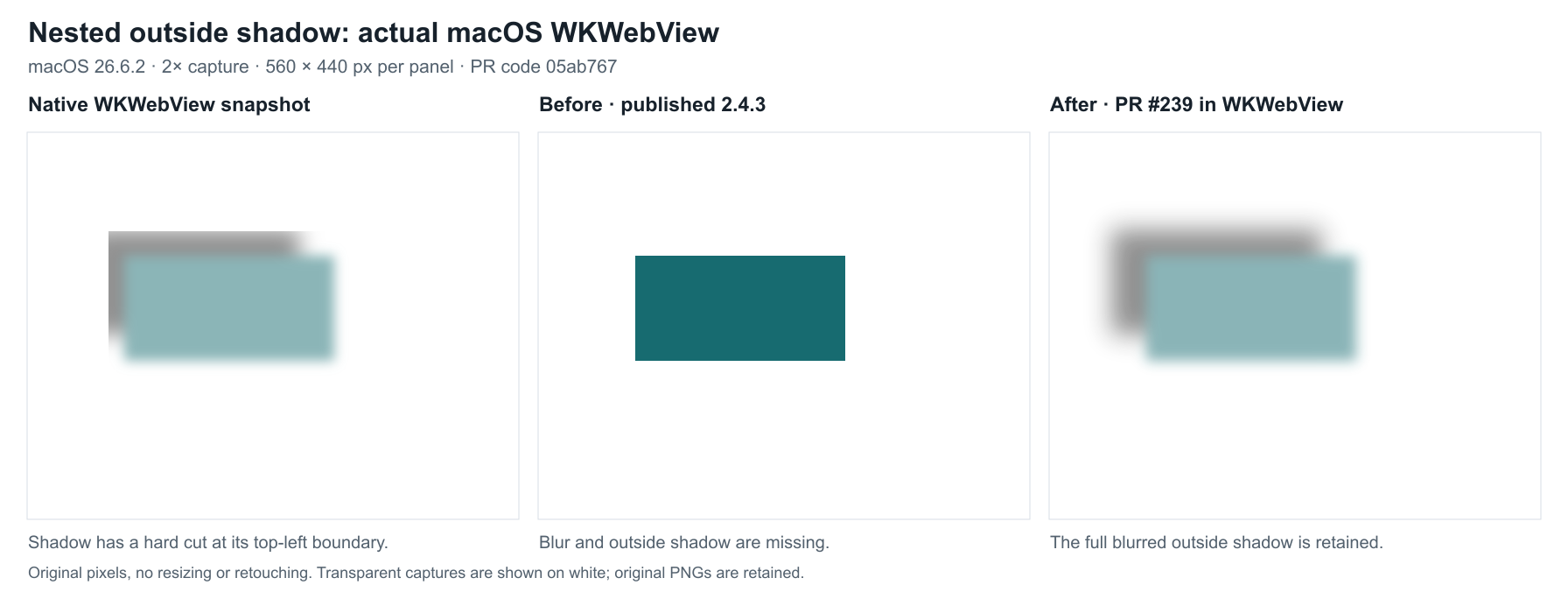
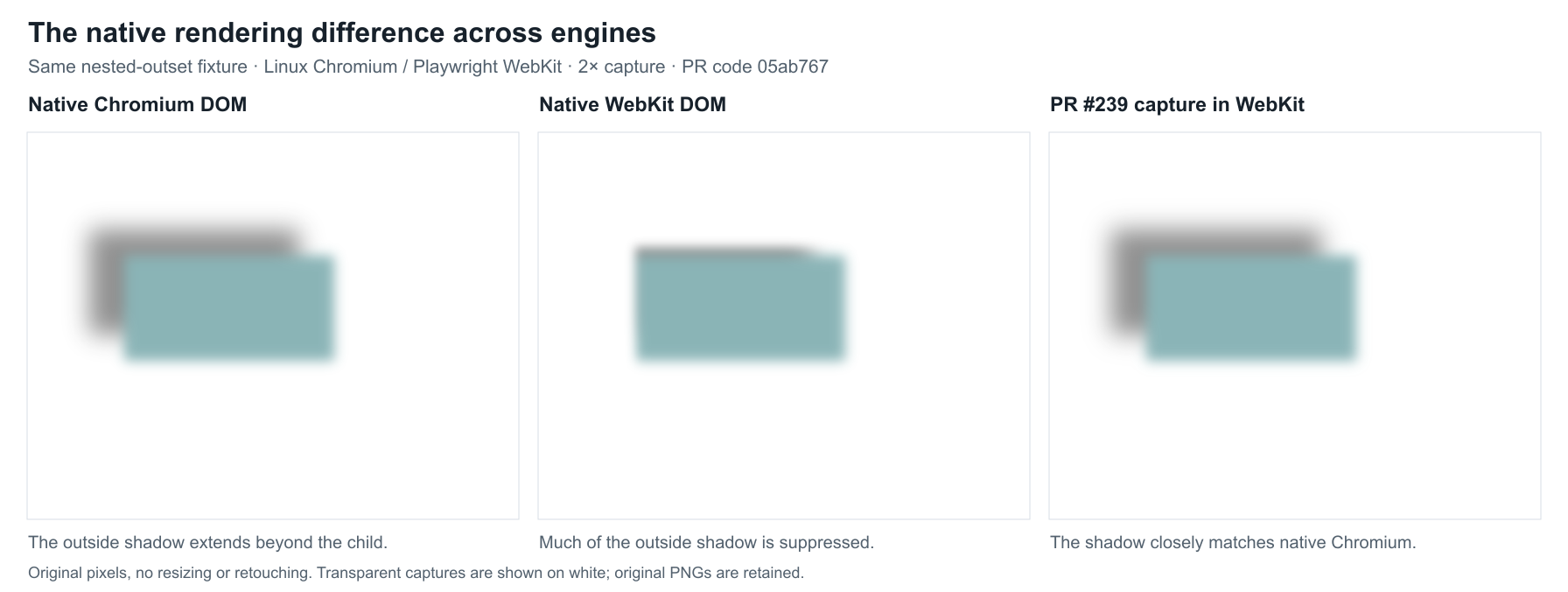
Download original PNGs and view their provenance.
The live WebKit reference loses or clips an outside shadow nested under another filtered element. The discrepancy differs between Playwright WebKit 26.4 and system WKWebView 26.5.2. The draft retains the specified shadow and improves the release, but does not match these native references exactly:
| Nested outside shadow | Published 2.4.3 MAE | Draft MAE |
|---|---|---|
| Playwright WebKit, 1x/2x | about 12.15/255 | about 4.10/255 |
| System WKWebView, 1x/2x | about 13.91/255 | 2.05–2.24/255 |
The report marks this case nativeShadowDiscrepancy. The portable WebKit probe compares this fixture with the independently captured Chromium DOM using the same 2/255 threshold, and checks retained outside-shadow pixels. A release-relative ratio is unsuitable across platforms with different Canvas filter support. Native WebKit and baseline errors remain recorded. The macOS host additionally requires a twofold error reduction versus its release capture. These gates are explicitly separate from the native WebKit threshold for the other cases. Do not describe it as pixel-equivalent to native WebKit. In the 16 September 2026 maintainer review, preserving the complete shadow and documenting this native difference was accepted. This is an accepted rendering policy, not a resolution of all remaining PR work.
Readiness checklist
CI execution and publication dependencies are defined by the committed workflows; check the actual PR revision's CI status separately. General filter chains, multiple drop shadows, transformed/blended surfaces, SVG overflow and library-wide stylesheet readiness remain potential follow-ups. The measured over-budget legacy performance gap and remaining SVG cost are described in the native fast-path report. The demo continues to guard cloned stylesheet readiness in onclone.
The related shadow report #223 was marked fixed in 2.3.2. This draft supplies separate fixtures against 2.4.3; it does not assume that report has the same cause.
AI-assisted investigation and implementation.